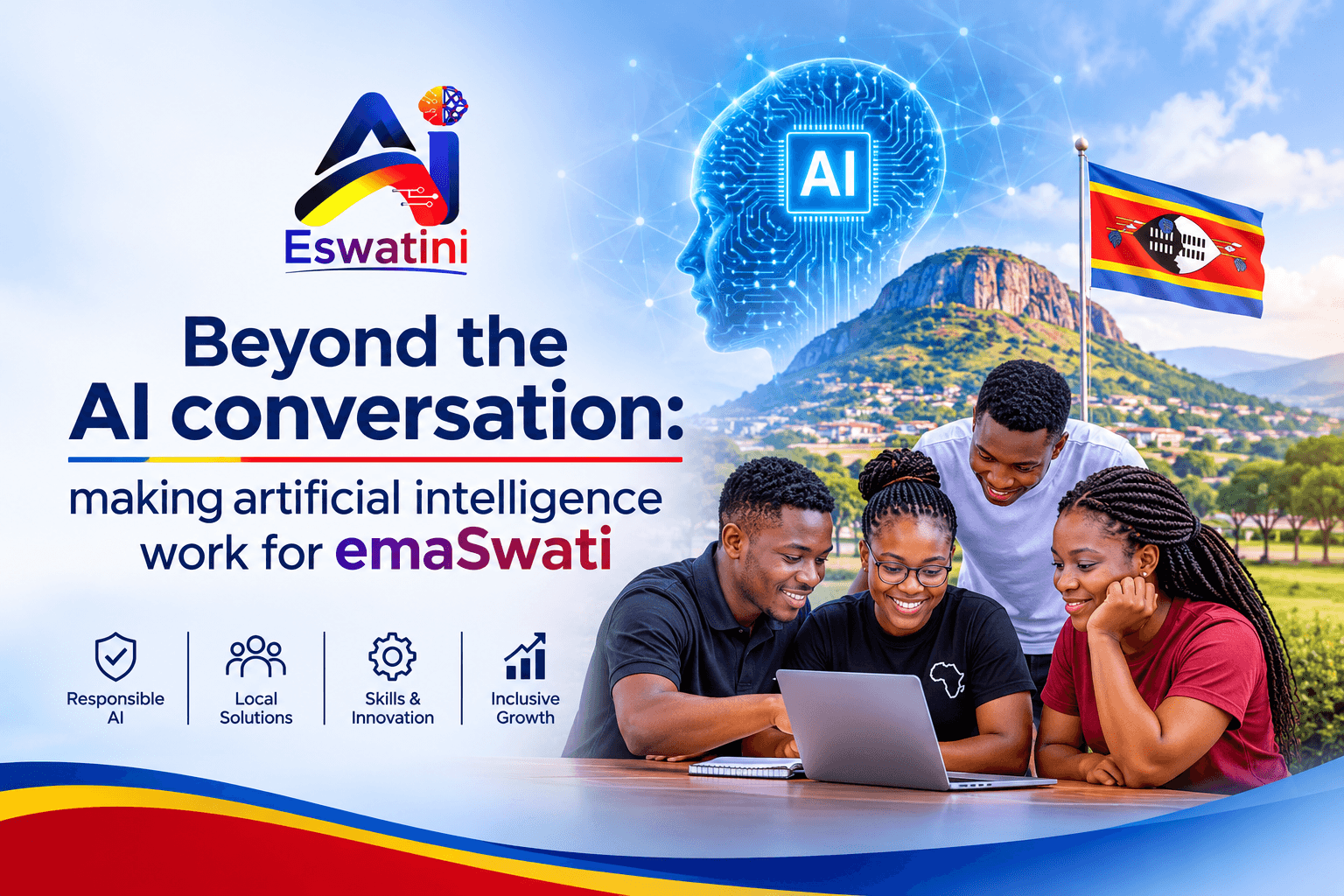
Eswatini’s artificial intelligence conversation is moving from broad ambition towards more specific questions about policy, skills and practical use. National discussions have set out priorities, a regional meeting has helped lay the groundwork for future AI policy, and local programmes are connecting technical learning with institutional challenges. [1–3]
From within AI Eswatini, we believe the next step should be judged by a different standard: not how much attention AI receives, but whether it produces useful, fair and accountable results for emaSwati. The opportunity is not simply to adopt technology developed elsewhere. It is to build the skills, partnerships and safeguards that allow people in Eswatini to shape how that technology serves their priorities.
From regional dialogue to national decisions
From 16 to 18 September 2026, Eswatini hosted a COMESA Regional Validation Meeting on a draft study of artificial intelligence and emerging technologies. Held under the World Bank-funded Inclusive Digitalization in Eastern and Southern Africa programme, the meeting brought together member states, regional organisations, development partners and experts to review evidence for future regional policy instruments. [2]
The study is intended to inform a Regional AI Strategy, Model Policy Guidelines and a Model Regulatory Framework. Discussions covered skills, innovation, practical applications, infrastructure, data, investment and safeguards for responsible AI. These were steps towards developing regional frameworks not an announcement that those frameworks had already been adopted. [2]
For Eswatini, the process also connects to an ongoing national policy effort. At the country’s inaugural AI Indaba in November 2024, government announced plans to develop a National AI Strategy and a Fourth Industrial Revolution Strategy, identifying education, health and agriculture as important areas for AI integration. [1]
At the September 2026 regional meeting, Minister Sikhumbuzo Dlamini, representing the ICT Minister, said Eswatini had recently engaged a consultant to draft its National AI Strategy. According to the Times of Eswatini, he also emphasised that regional policy should reflect differences in national infrastructure, readiness and institutional capacity. [4]
The distinction between drafting and adoption matters. An Africa AI Policy Lab country profile dated 7 October 2026 reported that its desk research had found no adopted national AI strategy or published draft. The profile expressly cautions that those desk-research findings had not been verified by fellows. They should therefore be read as a qualified account of publicly available evidence, not conclusive proof of the government’s current position. [5]
The practical priority is clarity: what is being developed, who can contribute, how implementation will be funded, and how the public will know whether it is working?
The test is local impact
A useful AI agenda should begin with problems people and institutions already recognise: supporting teachers, improving access to public services, helping farmers make decisions or protecting people from fraud. The starting point should be the need not the availability of a new tool.
IndabaX Eswatini 2026 offered a setting for connecting those questions with technical learning. Hosted by the University of Eswatini’s Department of Computer Science at the Central Bank of Eswatini auditorium on 23–24 September, its theme was “Ensemble Machine Learning for Resilient Decision Making in Eswatini.” [3, 6]
The programme connected machine learning with financial inclusion, communications regulation, tax administration and financial supervision. It listed contributions from the Centre for Financial Inclusion, Eswatini Communications Commission, Eswatini Revenue Service and Financial Services Regulatory Authority, alongside an AI Eswatini session on building the country’s AI ecosystem. [3]
It also included poster presentations, an introduction to Google Colab and Kaggle, a session on secure AI agent systems and a practical exercise on building a decision-making AI agent. That combination matters: a local AI ecosystem needs opportunities to examine institutional problems and opportunities to learn how systems are built. [3]
But a programme of talks and practicals is a starting point, not evidence of public benefit. The next questions should concern what participants build, how those systems are tested and whether institutions can use them responsibly.
Fraud shows why problem definition matters
Fraud provides a concrete example of a locally significant problem around which technology, public awareness and institutional action could be brought together.
In its report “EmaSwati defrauded E6.2 million in cyber crime,” the Times of Eswatini cited police statistics showing that 605 fraud-related cases involving E6,272,075.30 were reported countrywide between April 2025 and March 2026. The report discussed the evolution of facata scams, including fraudulent messages, telephone calls and impersonation of trusted organisations. [7]
Those figures require careful handling. They describe the report’s broader category of fraud-related cases; they should not be presented as a verified count of 605 facata mobile-money scams. The same article separately identified 11 reported attempts involving callers impersonating bank employees, which police said had been unsuccessful. [7]
For local AI builders, this is a useful reminder that defining the problem is part of building the solution. A proposal to flag suspicious messages should explain which type of fraud it targets, which languages and communication channels it covers, and what evidence would demonstrate that it helps.
Our view is that any such proposal should be assessed against practical questions before being promoted as a public service. Can it distinguish a scam from a legitimate message? How often does it miss fraud or raise a false alarm? Can it be tested without exposing people’s financial information? Who would maintain it as scam tactics change?
The ambition should be to complement not replace public awareness, secure financial services and effective investigation. A promising research idea deserves support, but it should not be described as a proven protection before it has been evaluated.
Public-sector AI needs more than a winning model
The IndabaX programme also introduced a Zindi challenge focused on VAT filing and payment. The competition asked participants to predict whether returns would be filed or paid on time, and how late they might be, using historical records and information available before the relevant deadlines. [3, 8]
The challenge ran from 25 September to 31 October 2026. Zindi states that the top three solutions will be presented to the Eswatini Revenue Service for consideration, with results scheduled for release on 6 November. As of this article’s publication, that scheduled results announcement is still ahead. [8]
This is a specific public-sector use case, but it is not yet evidence of an operational tax system or improved revenue collection. Presentation for consideration is different from adoption, and performance in a competition is different from performance in everyday administration.
For us, the value of such a challenge lies partly in the questions it creates for the next stage. Would predictions help officials offer earlier assistance to taxpayers? How would errors be identified and corrected? What oversight would apply before a prediction influenced an administrative decision?
A responsible pathway should make those questions part of the project not an afterthought once a model has been selected.
Skills must translate into practical capability
Education offers another grounded perspective. A 2025 study surveyed 94 secondary-school agriculture teachers in Manzini Region. It reported limited familiarity with AI tools alongside generally positive perceptions of their potential to support student engagement and personalised learning. The authors recommended targeted professional development. [9]
The study does not represent every teacher in Eswatini, nor does it demonstrate that AI improved classroom outcomes. Its value is narrower: it points to a gap between interest in AI and familiarity with its use among a particular group of educators. [9]
That gap should shape how training is designed. We should ask whether educators have time to practise, guidance on appropriate use and opportunities to assess whether a tool supports their teaching objectives.
AI Eswatini’s website reports that more than 200 emaSwati learners were upskilled through its Year One DataCamp scholarship partnership. The University of Eswatini AI Academy also advertises practical AI courses for educators and professionals. These are indicators of training activity, though they do not by themselves establish lasting skills gains or workplace impact. [10, 11]
As an organisation involved in this work, we should welcome stronger measures of progress. Participation totals matter, but so do completion, demonstrated skills, locally relevant projects and the ability to apply learning safely.
Access should remain central. Who can participate? What support do learners need? Are opportunities reaching people beyond those already connected to universities, professional networks and technology communities?
Build trust as capability grows
Eswatini’s wider digital foundations will shape what AI can deliver. UNDP’s 2024 Digital Readiness Assessment placed the country at the “systematic” stage, with an overall score of 2.6. Its recommendations included improving digital literacy and equitable internet access, strengthening innovation and research, and developing data-management and emerging-technology regulation. [12]
That is a digital-readiness assessment, not a current measure of national AI capability. Nevertheless, its priorities provide a useful foundation for deciding where AI investment should sit alongside broader digital-development needs. [12]
Our view is that trust should be built into that investment from the beginning. People should be able to understand what an AI-enabled service is intended to do, what information it uses, where its limitations lie and who remains accountable for its decisions.
For projects that could affect access to services, money or opportunities, we should expect clear evaluation plans, appropriate human oversight and a way to raise concerns. We should also expect developers and institutions to explain when a simpler, non-AI approach may be more suitable.
These expectations are not arguments against innovation. They are part of making innovation worthy of public confidence.
Measure what changes for people
Eswatini now has several points from which to build: a national strategy-development process, participation in regional policy work, institutional interest in applied machine learning and local training initiatives. Each serves a different purpose, and none should be mistaken for proof that AI is already delivering benefits at scale. [2-4, 10]
The next phase should connect them around clearly defined problems and measurable results. Policymakers, researchers, local builders, educators and affected communities should help determine what success looks like before a system is introduced.
At AI Eswatini, we believe the strongest measure of progress is impact: whether a service becomes more useful, whether a burden is reduced, whether access becomes fairer and whether people can question decisions that affect them.
That requires honest distinctions between an announcement and a funded programme, a prototype and a deployed service, and an encouraging result and a proven outcome.
The strongest AI story for Eswatini will not be about technology arriving. It will be about emaSwati shaping it and having the evidence to show that it serves their priorities.
Thank you for reading this article to the end. I hope you’ll join the conversation, contribute your ideas and share your perspective on how AI can serve Eswatini. I wrote these reflections while listening to music that carries stories across cultures: Oliver Mtukudzi’s “Neria,” whose Afro-jazz sound, often associated with Tuku Music accompanies the story of a rural Zimbabwean woman facing poverty and grief after her husband’s death; “Diamonds on the Soles of Her Shoes,” performed by Paul Simon and Ladysmith Black Mambazo on The Concert in Hyde Park, a masterful blend of worldbeat, pop-rock and South African traditions such as isicathamiya and mbaqanga; and “Knockin’ on Heaven’s Door,” Dolly Parton with Ladysmith Black Mambazo in a beautiful cross-cultural collaboration. Their different voices and traditions made a fitting soundtrack as I reflected on technology, people and the challenges our societies face.
References
Web sources accessed or reviewed for this article on 3 November 2026. Numbered citations in the text correspond to the entries below.
[1] United Nations Eswatini. “UN Eswatini Joins Ministry of ICT to Explore Artificial Intelligence for Sustainable Development.” 25 November 2024.
[2] COMESA, Inclusive Digitalization in Eastern and Southern Africa (IDEA). “PRESS STATEMENT: COMESA Advances Responsible AI Dialogue.” 25 September 2026.
[3] University of Eswatini. “IndabaX Eswatini 2026 Programme.” 23–24 September 2026.
[4] Times of Eswatini. “Eswatini hosts regional push for practical AI policies.”
[5] Africa AI Policy Lab. “Country Profile on AI Governance: Eswatini.” Version 1.2, 7 October 2026.
[6] University of Eswatini, Department of Computer Science. “Deep Learning IndabaX 2026.” Event details, 23–24 September 2026.
[7] Times of Eswatini. “EmaSwati defrauded E6.2 million in cyber crime.” June 2026.
[8] Zindi. “IndabaX Eswatini: VAT File & Pay Predictive Analytics Challenge.” Competition brief and timeline.
[9] Dlamini, N. N., and V. C. Asogwa. “Perceptions On Utilisation of Artificial Intelligence Among Secondary School Agriculture Teachers in Eswatini.” International Journal of Research and Innovation in Applied Science, 10(10), 2025, pp. 2548–2558. DOI: 10.51584/IJRIAS.2025.10100000207.
[10] AI Eswatini. Official website: team and Year One DataCamp scholarship partnership information.
[11] University of Eswatini AI Academy. Official website: course and programme information.
[12] United Nations Development Programme. Digital Readiness Assessment Report: Kingdom of Eswatini. 2024.