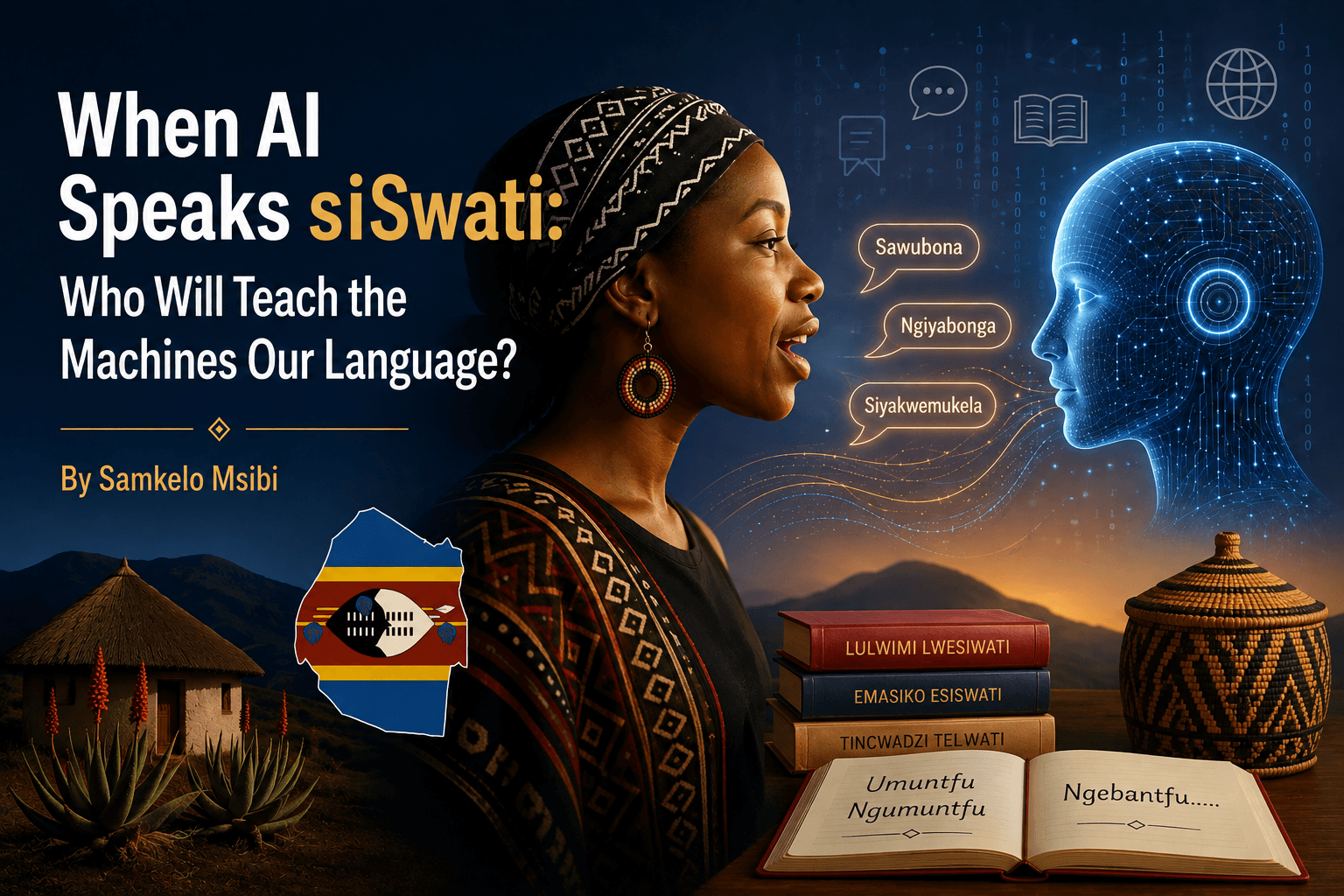
Artificial intelligence is rapidly becoming an intermediary between people and information. We increasingly ask machines to explain, translate, summarize, teach, recommend and make sense of the world around us.
Yet there is an uncomfortable question beneath this progress:
Whose language does artificial intelligence understand?
For speakers of English and a relatively small group of highly represented languages, advances in generative AI can create the impression that the language problem has largely been solved. It has not.
Across Africa, many languages remain significantly underrepresented in the datasets, benchmarks and computational resources used to develop modern AI systems. UNESCO has recently described African languages as a major “blind spot” in contemporary AI, highlighting how systems trained predominantly on dominant-language content can perform considerably less effectively when confronted with African languages and cultural contexts.[1]
For Eswatini, this is not an abstract research problem.
It raises a strategic question about our digital future:
If artificial intelligence becomes part of how we learn, work, access public services and participate in the digital economy, what happens if these systems cannot adequately understand siSwati?
The answer should concern researchers, policymakers, educators, technologists and industry leaders alike.
The problem is not the language. It is the data.
In natural language processing, languages such as siSwati are frequently described as low-resource or under-resourced.
The terminology can be misleading.
It does not mean that the language lacks richness, complexity or speakers. It means that the computational resources required to develop and rigorously evaluate language technologies large digital corpora, annotated datasets, speech recordings, dictionaries, parallel translations and standardized benchmarks are comparatively limited.
This distinction matters.
Modern AI systems learn statistical and linguistic patterns from data. When enormous quantities of high-quality English material are available but substantially less machine-readable siSwati content exists, the resulting technological imbalance should not surprise us.
Research communities across Africa have been confronting this challenge for several years. Masakhane, a pan-African research community focused on African-language NLP, has demonstrated the value of combining machine-learning expertise with linguistics, local knowledge and participatory dataset development.[2] UNESCO similarly argues that addressing the digital language divide requires participation from researchers, communities, governments, translators, content creators and technology developers rather than treating it as an engineering problem alone.[3]
This gives us an important starting principle:
siSwati is not technologically incapable. It is computationally underrepresented.
Those are very different problems.
And the second is one we can solve.
We are not starting from zero
It is equally important that we do not frame the conversation as though no research exists.
A particularly important contribution was published by Gaustad, McKellar and Puttkammer of North-West University's Centre for Text Technology in 2024. Their Siswati dataset contains both English-Siswati parallel textual data and monolingual Siswati material and was developed for machine translation while also supporting broader NLP development and evaluation.[4]
That work matters because language technologies require precisely these kinds of foundational resources.
Parallel corpora help systems learn relationships between languages. Monolingual corpora help researchers model the linguistic patterns of a language itself. Such resources can contribute to machine translation, information retrieval, spell-checking, language modelling and other downstream applications.
The publication of such datasets demonstrates that meaningful technical foundations already exist.
But a foundation is not an ecosystem.
The next challenge is determining how we systematically expand these resources, evaluate them, govern them and translate them into technologies that solve real problems for Emaswati.
That requires leadership beyond individual research projects.
Language is not simply a collection of words
One of the greatest mistakes we could make would be to treat the development of siSwati AI as a translation exercise.
Language contains far more than vocabulary.
It carries social relationships, history, humour, metaphor, oral traditions, proverbs and assumptions about the world. UNESCO has warned that AI systems built predominantly around other linguistic and cultural environments may fail to adequately capture these dimensions when applied to African contexts.[1]
Consider a siSwati proverb.
A system might translate every individual word correctly and still misunderstand the meaning entirely.
Consider a conversation involving code-switching between siSwati and English. Or a speaker using an expression that is obvious to another Liswati but uncommon in formal written material.
Then consider speech recognition.
Age, geography, speaking speed, background noise, pronunciation and conversational context can all influence performance.
A system that merely produces convincing siSwati sentences should therefore not automatically be regarded as a system that understands siSwati.
Researchers need benchmarks capable of testing that distinction.
We should be evaluating semantic understanding, translation quality, cultural context, speech recognition, factual accuracy and performance across different demographic and linguistic settings.
That is where serious language technology begins.
What could this mean in practice?
The significance of this research becomes clearer when we stop thinking about language models and start thinking about citizens.
Consider agriculture.
A farmer should eventually be able to describe a crop disease in siSwati, perhaps through a voice message, and interact with an agricultural advisory system without having to formulate the question in English first.
Consider education.
A learner struggling with an English explanation of a scientific or mathematical concept could ask for another explanation in siSwati not merely a literal translation, but an explanation appropriate to the learner's linguistic and educational context.
Consider public services.
A citizen should be able to interact naturally with digital government information using either of the country's official languages.
Consider accessibility.
Speech recognition and text-to-speech systems could make digital services considerably more accessible to citizens who are more comfortable communicating orally than navigating complex digital interfaces.
And consider cultural preservation.
Properly governed language technologies could help digitize, search and preserve historical documents, oral histories, terminology and other forms of knowledge that might otherwise remain outside the emerging AI ecosystem.
These possibilities illustrate why language technology should not be viewed merely as a research curiosity.
It can become digital public infrastructure.
UNESCO's Global Roadmap for Multilingualism in the Digital Era makes a similar argument at the international level, calling for equitable representation of languages across machine translation, speech recognition, natural language processing and other digital technologies.[5]
For Eswatini, the implication is straightforward:
language inclusion will increasingly become digital inclusion.
But there is a question we must answer before collecting millions of words
Who owns the data?
This question deserves as much attention as model accuracy.
Suppose we build a national siSwati speech dataset consisting of thousands of hours of conversations.
Who owns those recordings?
Did the speakers consent to their voices being used to train artificial intelligence?
Can the dataset be transferred outside Eswatini?
Can a commercial organization train a proprietary product using it?
Can an Eswatini university researcher access the same dataset?
If a foreign organization funds the collection, does funding automatically justify ownership?
And if a model trained partly on the language and knowledge of Emaswati becomes commercially valuable, what obligations if any remain toward the communities from which those resources originated?
These questions are not arguments against international collaboration.
Quite the opposite.
Eswatini will benefit enormously from collaboration with African research networks, universities, international laboratories, technology companies and development partners.
But good partnerships require clarity.
Collaboration and ownership are not the same thing.
We should welcome expertise and investment while remaining deliberate about consent, privacy, intellectual property, access, benefit-sharing and long-term stewardship of nationally significant language resources.
The future value of language data should not be underestimated simply because its value is difficult to see today.
Who has the authority to teach a machine siSwati?
There is also a deeper governance question.
Who determines whether an AI system's siSwati is correct?
The answer cannot be machine-learning researchers alone.
A credible national language-technology effort would require computer scientists working alongside linguists, educators, cultural experts, historians, public institutions and, critically, ordinary speakers.
Technical experts understand models.
Linguists understand language structure.
Teachers understand how language is used to communicate knowledge.
Cultural experts understand context that may never appear in a conventional dataset.
Communities understand how the language actually lives.
This multidisciplinary approach is consistent with lessons emerging from African NLP initiatives such as Masakhane, where participatory research has become central to building better language resources.[2][3]
Leadership in this space therefore means resisting the temptation to ask only:
“Which model should we use?”
The more important questions are:
Who should participate? What should we build? Who benefits? How will quality be measured? And how will these resources remain useful to future generations?
This is also a constitutional question
The importance of siSwati in Eswatini is not merely cultural.
Section 3(2) of the Constitution recognizes siSwati and English as the official languages of the country.[6]
That recognition should encourage us to think seriously about what official-language equality means in an increasingly digital state.
Twenty years ago, the question might primarily have concerned documents, education, broadcasting or government communication.
Today we must add another domain:
artificial intelligence.
If future public-service chatbots, educational platforms, digital assistants and automated information systems perform exceptionally in English but poorly in siSwati, we will have created a new form of digital inequality even while expanding access to technology.
Technological progress should not require citizens to abandon their preferred language in order to participate fully.
Eswatini needs a language technology agenda
The response does not need to begin with an expensive attempt to build a national large language model.
That would confuse ambition with strategy.
A stronger approach would begin with foundational capabilities.
First, we should understand what already exists. Eswatini needs an inventory of available siSwati corpora, dictionaries, translations, speech resources, academic research and digital archives.
Second, we need better datasets. This should include carefully curated text, parallel corpora and, importantly, diverse speech data.
Third, we need national benchmarks. We cannot improve what we cannot measure. Researchers should be able to evaluate translation, speech recognition, question answering and culturally specific language understanding against transparent baselines.
Fourth, we need governance. Dataset licences, consent mechanisms, privacy protections, access conditions and benefit-sharing arrangements should be considered at the beginning of projects, not after the data has already been collected.
Fifth, we need people. Universities should be encouraged to develop expertise at the intersection of NLP, linguistics, machine learning and responsible data governance.
Sixth, we should build applications around real national needs. Agriculture, education, healthcare information, public services and accessibility provide stronger starting points than building technology simply because it is fashionable.
And finally, these efforts should be collaborative.
Government cannot do this alone.
Universities cannot do it alone.
Technology communities cannot do it alone.
Private industry cannot do it alone.
And international partners should not be expected to define the agenda for us.
The most sustainable model is one in which these stakeholders contribute different capabilities toward a shared national objective.
The opportunity before us
There is a tendency for smaller countries to view frontier technologies as something that happens elsewhere.
The largest models may indeed be trained elsewhere.
The largest data centres may be built elsewhere.
And the largest technology companies may be headquartered elsewhere.
But that does not mean the most important decisions about our participation in the AI economy must also be made elsewhere.
Eswatini does not need to compete with the world's largest AI laboratories in model size.
We need to become exceptionally good at identifying the problems that matter to us, developing the data required to solve them, building local expertise and forming partnerships that strengthen rather than replace domestic capability.
Language is an excellent place to begin.
Because if we build the right foundations, siSwati language technology could become more than an AI research project.
It could become a platform upon which researchers build new models, entrepreneurs create products, government improves services, educators expand access to knowledge and future generations preserve their linguistic heritage.
That is a far more consequential ambition than simply making a chatbot speak siSwati.
Who will teach the machines?
For most of the history of computing, humans have adapted themselves to machines.
We learned programming languages.
We learned search syntax.
We learned menus, commands and interfaces.
Artificial intelligence is beginning to reverse that relationship.
We are entering an era in which we increasingly expect machines to understand us.
But machines will not learn siSwati simply because artificial intelligence becomes more powerful.
Someone must collect the data.
Someone must preserve the knowledge.
Someone must record the voices.
Someone must establish the standards.
Someone must evaluate the models.
Someone must protect the rights of the people represented in those datasets.
And someone must ensure that the resulting technology serves the society from which that knowledge came.
That responsibility cannot be outsourced entirely.
The question before Eswatini is therefore larger than whether AI can speak siSwati.
The question is whether we are prepared to build the institutions, skills, datasets and partnerships necessary to ensure that it does so accurately, responsibly and on terms that benefit Emaswati.
Because in the age of artificial intelligence, preserving a language will increasingly mean more than ensuring that our children can speak it.
It will also mean ensuring that the technologies shaping their future can understand it.
References
[1] UNESCO. (2026). African languages, the blind spot of AI. UNESCO discusses the persistent underrepresentation of African languages and cultural contexts in AI systems and the consequences for education and access to technology.
[2] UNESCO. Putting African science in the dictionary. The article discusses Masakhane's multidisciplinary approach to African-language NLP and the importance of participatory language-resource development.
[3] UNESCO. Strengthening multilingualism through datasets for low-resourced languages. UNESCO highlights participatory dataset development involving researchers, translators, content creators, curators, language technologists and evaluators.
[4] Gaustad, T., McKellar, C. A., & Puttkammer, M. J. (2024). Dataset for Siswati: Parallel textual data for English and Siswati and monolingual textual data for Siswati. Data in Brief, 54, 110325. DOI: 10.1016/j.dib.2024.110325. The dataset provides English-Siswati parallel material and monolingual Siswati data for machine translation and broader NLP research.
[5] UNESCO. (2025/2026). Global Roadmap for Multilingualism in the Digital Era: Advancing the Role of Language Technologies. The roadmap calls for equitable representation of languages across technologies including machine translation, speech recognition and NLP.
[6] Constitution of the Kingdom of Swaziland, 2005, Section 3(2). The Constitution provides that siSwati and English are the official languages.